

Race management training
TRAINING SCHEDULE
OOD training to Club level and Open level
Box race management training
This training agenda is designed for an overlapping dual session. The OOD training kicks off first, and the Box training blends into the session later on.
Each session will require timing confirmation, so here is a PDF and scroll below that to read an outline:
Training dates and meet up times can change, here is an outline.
Where? WHO? Activity Duration
Clubhouse OOD Phase 1 +Orientation at clubhouse 15 mins
Grounds OOD Phases 2,3,4 30 mins
Clubhouse Box Arrive at the clubhouse 15 mins
Smithy OOD + Box Phase 4,5 1 hour +
Smithy OOD + Box Practice & potentially run a Junior race 30 mins
Total ~2hr 30
Aims
OOD training is to refresh OOD people who have experience and introduce all the new paperwork. Covers the responsibilities of the Officer of the Day (OOD) at Tamesis Club. It is useful for everyone to know the routines and the tasks, to help out if the OOD is delayed. For example, knowing where the radios are kept.
Box training is to guide a new volunteer through the role of Box by introducing race management. This will include practicing in a practical way.
The training phases follow a chronological timeline, emphasizing the management of club activities, racing operations, and site security.
Phase 1: Pre-Duty Preparation (OOD)
Training here focuses on the administrative and organizational steps required before the day of the event.
(Immediate acceptance of duty from roster notification)
Confirming availability
oTraining Topics: Inbox management, Portal access, Duties roster online. Confirming availability via the SCM roster.
oRationale: Early personal calendar management and co-ordination with roster team.
(The Week Prior)
Roster and Team Coordination
oTraining Topics: Confirming duties via the SCM roster and contacting the assigned team (Box assistants and Patrol crew).
oRationale: To ensure a full team is committed and to identify any needs for qualified replacements early.
Environmental and Event Research
oTraining Topics: Reviewing Sailing Instructions (SI), checking Stream Watch for river flow rates, and liaising with the Junior lead or Class Captains.
oRationale: To prepare for specific event needs and anticipate weather-related risks.
Phase 2: Arrival and Club Opening (OOD)
Training here focuses on the OOD's role as the primary person responsible for site access and early opening up.
(Timeline: 09:30 Sunday / 18:15 Thursday)
Site Access and Security
oTraining Topics: Operating the main gate combination lock and using the designated keys or keysafe for the clubhouse and boatshed.
oRationale: To ensure the facilities are open for members to begin rigging and using the changing areas.
Initial Coordination
oTraining Topics: Checking in with kitchen staff for catering timings and greeting visitors or prospective members.
oRationale: To integrate the day's racing with club social activities and maintain a welcoming environment.
Phase 3: Flagpole Protocol and Safety Readiness (OOD)
Training here moves to visual signalling and establishing a safe environment for the day.
(Timeline: 60-90 Minutes Before Start)
Club Flagpole Operations
oTraining Topics: Hoisting the Red Ensign on the yard arm and the Club Burgee (or senior Officer's flag) to the masthead.
oRationale: Traditional signals to indicate the club is officially open and which officers are present.
Formal Risk Assessment
oTraining Topics: Completing the risk assessment on the back of the race sheets, evaluating river flow and weather.
oRationale: Safety is the "prime concern"; this documented process ensures the OOD has considered mitigations like additional patrol boats.
Personal Buoyancy Signals
oTraining Topics: Hoisting Flag 'Y' if conditions require mandatory buoyancy aids (beyond the automatic winter mandate).
oRationale: To clearly communicate safety requirements to all competitors and crew members before they launch.
Phase 4: Patrol Boat and Race Box Activation (OOD)
Training here covers the technical setup of the "Smithy" (Starter's Box) and the safety fleet.
(Timeline: 45-60 Minutes Before Start)
The Smithy (Starter's Box) Setup
oTraining Topics: Powering up the hooter, microphone, and clock; hoisting the transit mast flags (Orange/Blue).
oRationale: To ensure the primary race command center is functional and the start/finish line is visible.
Safety Fleet Deployment
oTraining Topics: Briefing the patrol crew, checking boat equipment (VHF, fuel, First Aid), and clearing jetties of bird excrement, emptying bilge on Tamesis III. Loading the marks.
oRationale: To ensure the safety team is prepared for 360-degree surveillance and recovery.
Course Setting
oTraining Topics: Selecting a course from the "Recommended Courses" folder and instructing the patrol boat to lay marks, including the Inner Distance Mark (IDM).
oRationale: To provide a fair racing route that accounts for wind direction and river traffic (like rowing eights).
Box training joins for Phase 5 and 6.
Focus on Race Management, which includes:
* setting up at the Smithy
* starting procedures
* bending on flags
* understanding the race sheet
* actually practicing a starting sequence (running off the atomic clock)
* monitoring and recording a race
* recalls
* shortening the course
* finishing
* race results.
Phase 5: Race Management (OOD + Box)
Training here focuses on the OOD's role as the Race Officer (RO) and Box support.
(Timeline: Start Sequence to Finish)
Setting up at the Smithy
oTraining Topics: All the details about preparation for running a race.
oRationale: To ensure power is on, electrics working, paperwork in place, flags are available.
Bending on Flags
oTraining Topics: Preparing the starting signals. Smithy flagpole.
oRationale: To understand position of flags on the pole, how to time the raising and lowering, how to handle two flags simultaneously.
Understanding the Race sheet
oTraining Topics: Understanding the different aspects of a Race Sheet.
oRationale: To understand how to record boats on the water on the Race Sheet and fill out lap times by class and then transfer to the final places on the right for the results management.
Starting Procedures
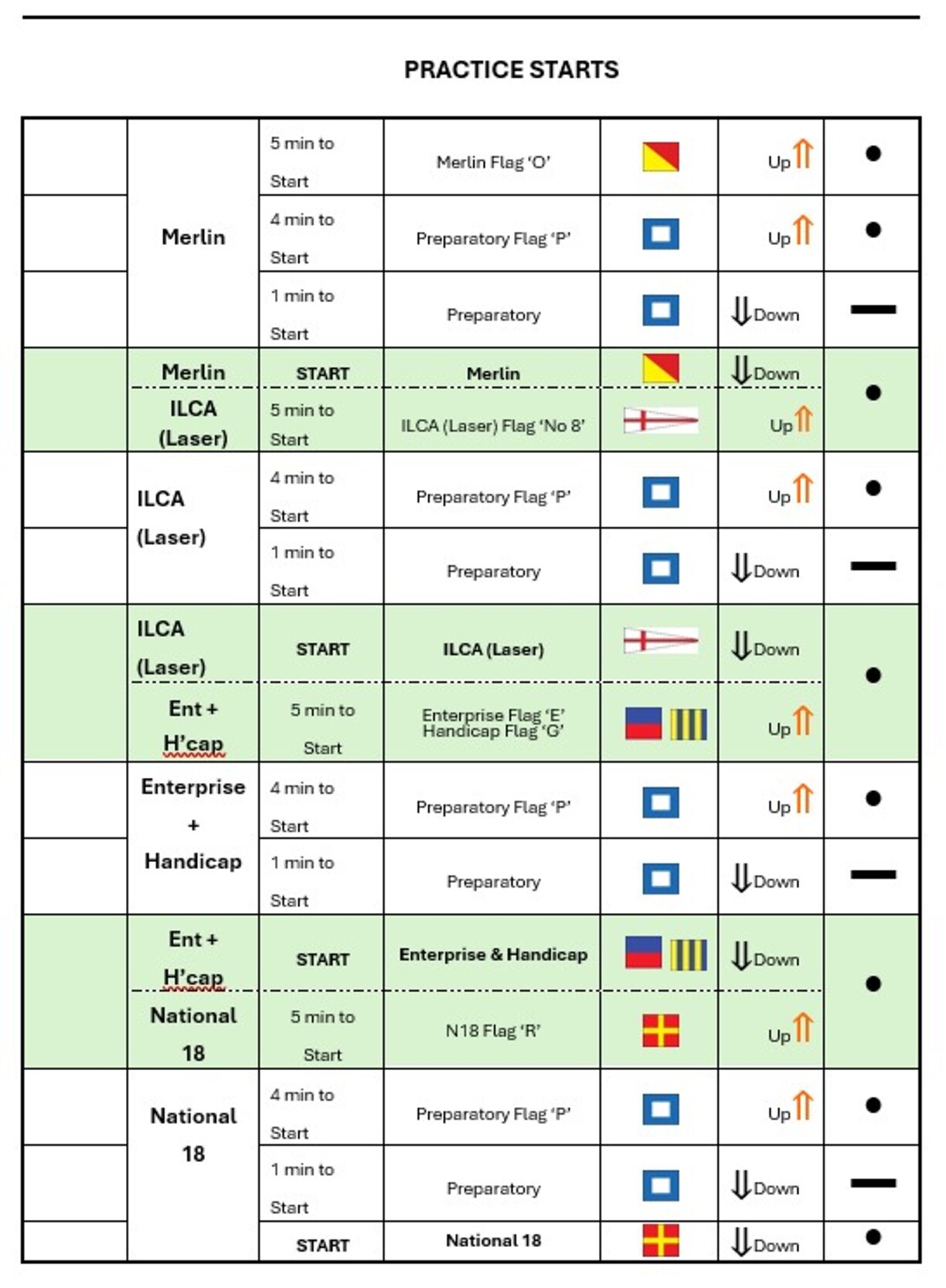
oTraining Topics: Executing the Rule 26 sequence (5-4-1-0) and using the microphone for competitor warnings. Different Flags and Sound signals. Priority of the flags. Importance of the atomic clock. Distractions.
oRationale: To manage orderly starts for multiple classes and ensure boats launch in a timely manner.
Practicing a Start / Individual Recall / General Recall / Course shorten
oTraining Topics: The various start sequences for Club racing or Pursuit / Open events. How to handle mishaps at the start.
oRationale: To physically manage orderly starts for multiple classes and ensure boats launch in a timely manner. To be able to manage recalls and shortening the course.
Ongoing Race Monitoring
oTraining Topics: Recording in draft as a full chronological record of the race. Use of video. Recording laps, identifying boats over the line (Flag 'X'), and deciding when to shorten the course (Flag 'S').
oRationale: To maintain accurate records for results and adjust the race length to meet "Target Times".
Finishing Protocols
oTraining Topics: Using the "Alert" sound for finishers and recording chronological finish times on the race sheet.
oRationale: To finalize results correctly and verify that all boats have safely returned to the bank.
Race Results
oTraining Topics: How to ensure the race sheet is completed correctly in the FINISHING ORDER columns by finish places with chronological time, by class. Picture communication to the club members Whatsapp "Tamesis Club Sailing".
oRationale: To post up results correctly and ensure race sheets are available for the Class Captains to update results.
Phase 6: Post-Race and End of Day Shutdown (OOD + Box)
The final training phase covers administrative duties and site security.
(Timeline: Post-Racing)
Protests, Documentation and Reporting
oTraining Topics: Photographing race sheets for WhatsApp distribution and handling any rules disputes or protest hearings.
oRationale: To provide rapid results to the club community and resolve on-water incidents fairly.
Equipment and Site Security
oTraining Topics: Stowing flags, charging VHF radios, locking the Smithy and boatshed, checking the changing rooms are locked with lights off. Checking the clubhouse windows are all closed, lights are all off and arming the clubhouse alarm before locking up.
oRationale: The OOD is typically the last to leave and must ensure all club assets are secured and powered down. If handing off responsibility for locking up, be sure to communicate well.
Site Exit
oTraining Topics: Ensuring the changing rooms are empty and locking the main car park gate.
oRationale: Final confirmation that the premises are locked and no members or visitors remain on-site.
Last updated 14:53 on 29 May 2026